


STEMI mimics: Difference between revisions
Mhockstein (talk | contribs) No edit summary |
Neil.m.young (talk | contribs) No edit summary |
||
| Line 1: | Line 1: | ||
==Background== | ==Background== | ||
*ST segment elevation (defined as 1mm in two contiguous leads or any Left Bundle Branch Block (LBBB) configuration meeting Sgarbossa criteria) | *ST segment elevation (defined as 1mm in two contiguous leads or any Left Bundle Branch Block (LBBB) configuration meeting Sgarbossa criteria) is a myocardial injury pattern until proven otherwise | ||
*When STEMI is unlikely, there are several other etiologies of ST elevation that can be considered | *When STEMI is unlikely, there are several other etiologies of ST elevation that can be considered | ||
*If myocardial ischemia is suspected but not (yet) evident, serial ECG’s are helpful, as only 72% of patients will receive the diagnosis of STEMI within the first 1.5 hrs | *If myocardial ischemia is suspected but not (yet) evident, serial ECG’s are helpful, as only 72% of patients will receive the diagnosis of STEMI within the first 1.5 hrs<ref>Riley RF, Newby LK, Don CW, et al. Diagnostic time course, treatment, and in-hospital outcomes for STEMI patients presenting with non-diagnostic initial ECG: A report from the AHA mission: lifeline program. Am Heart J. 2013; 165(1):50–56.</ref> | ||
==Mnemonic== | ==Mnemonic== | ||
The | The mnemonic “ELEVATION”, can help you remember STEMI mimics | ||
*'''E'''lectrolytes (Hyperkalemia) | |||
*'''L'''eft Bundle Branch Block | |||
*'''E'''arly Repolarization | |||
*'''V'''entricular Hypertrophy (Left) | |||
*'''A'''neurysm (Ventricular) | |||
*'''T'''hailand (Brugada Syndrome) | |||
*'''I'''nflammation (Pericarditis) | |||
*'''O'''sborne (J) Waves | |||
*'''N'''on-Ischemic Vasospasm | |||
==Electrolytes== | ==ELEVATION== | ||
* | ===[[Hyperkalemia|Electrolytes (Hyperkalemia)]]=== | ||
*T waves are peaked without any concave-down (tombstone) ST elevation | |||
*T waves of hyperkalemia should be tall, symmetrical, pointed, and narrow | |||
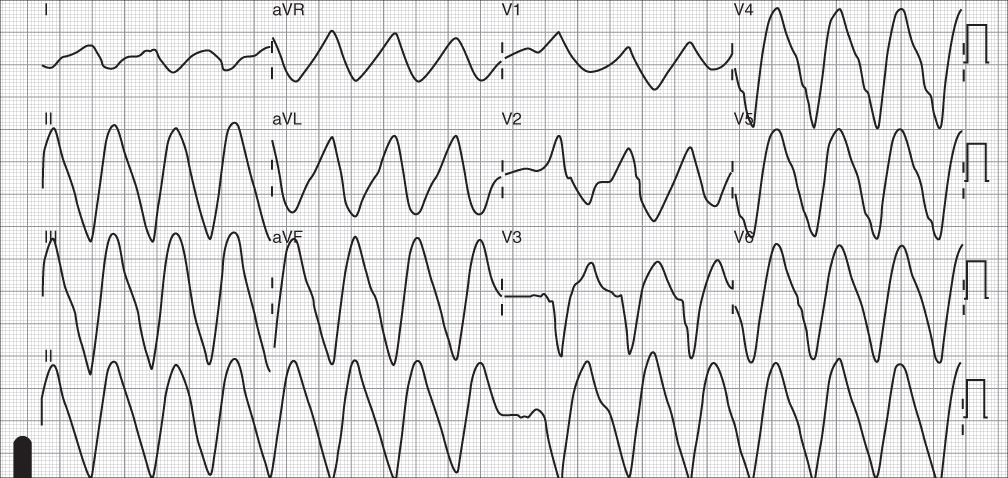
*Untreated hyperkalemia will progress to a [http://download.e-bookshelf.de/download/0000/7529/01/L-X-0000752901-0001831435.XHTML/images/c2f005.jpg sinuventricular] rhythm or a sine wave | |||
==Left Bundle Branch Block== | ===[[Left Bundle Branch Block]]=== | ||
*LBBB as well as any LBBB configuration (ex: RV pacing) can result in ST segment elevation, usually < 5mm | *LBBB as well as any LBBB configuration (ex: RV pacing) can result in ST segment elevation, usually < 5mm | ||
*In addition, may look for [http://www.learntheheart.com/cardiology-review/cabreras-sign/ Cabrera’s sign] or [http://www.learntheheart.com/cardiology-review/chapmans-sign/ Chapman’s sign] if infarct is suspected, though both are poorly sensitive | *Use [[Sgarbossa Criteria]] to determine if there is a concurrent infarct | ||
*RBBB does not typically give ST elevation, therefore in cases of RBBB, the usual STEMI rules apply | *In addition, may look for [http://www.learntheheart.com/cardiology-review/cabreras-sign/ Cabrera’s sign] or [http://www.learntheheart.com/cardiology-review/chapmans-sign/ Chapman’s sign] if infarct is suspected, though both are specitic but poorly sensitive | ||
*RBBB does not typically give ST elevation, therefore in cases of RBBB, the usual STEMI rules apply | |||
==Early Repolarization== | ===Early Repolarization=== | ||
* | *Normal variant often seen in young athletes | ||
*Some studies suggest an increased risk of VF in these patients, though the lifetime risk remains unclear | *Synonymous with J-point elevation (though not to be confused with a J-wave) i.e. elevation of the point where the QRS usually meets the isoelectric line | ||
*Some studies suggest an increased risk of VF in these patients, though the lifetime risk remains unclear | |||
==Ventricular Hypertrophy (Left)== | ===[[Left ventricular hypertrophy (LVH)|Ventricular Hypertrophy (Left Ventricular Hypertrophy)]]=== | ||
* | *LVH typically with ‘strain’ pattern: in these cases, the ST elevation should only be in V1-3, be concave-up (i.e. not a tombstone morphology), be discordant with the deep S wave, and not be elevated >2mm | ||
==Aneurysm== | ===[[Left ventricular aneurysm|Aneurysm (Ventricular Aneurysm)]]=== | ||
*After an MI, the walls of the ventricles can become aneurysmal and manifest on the surface 12 lead as persistent ST elevation in the territory of the old infarct | *After an MI, the walls of the ventricles can become aneurysmal and manifest on the surface 12 lead as persistent ST elevation in the territory of the old infarct | ||
*Q waves (from the previous MI) should | *Q waves (from the previous MI) should be present in the leads with persistent ST elevation | ||
*An | *An echo is required for the final confirmation | ||
*Takotsubo cardiomyopathy (broken heart syndrome) will present similarly. | *[[Takotsubo cardiomyopathy]] (broken heart syndrome) will present similarly. | ||
==Thailand== | ===[[Brugada syndrome|Thailand (Brugada Syndrome)]]=== | ||
* | *Cause by a mutation in a cardiac sodium channel (mostly SCN5A), was first described in Thailand in 1992 | ||
* | *May be responsible for 4-5% of all sudden cardiac deaths | ||
* | *3 described ECG types - Types 1 and 2 more commonly give ST elevation while type 3 has a “saddle back” appearance without ST elevation | ||
*Brugada pattern can be pharmacologically induced (ex: antiarrhythmics such as sodium channel blockers), precipitated by illness or fever, or be intermittent (will commonly see an incomplete RBBB pattern) | |||
==Inflammation== | ===[[Pericarditis|Inflammation (Pericarditis)]]=== | ||
* | *Look for diffuse ST elevation | ||
*In acute pericarditis, there might be PR elevation and ST depression in aVR only, but this is poorly sensitive | *PR depression is typically only seen in viral pericarditis, though the teaching is that this is a classic electrocardiographic sign of pericarditis | ||
*Consider the diagnosis of STEMI in favor of pericarditis when: there is ST depression anywhere (except for V1, aVR), ST elevation height in | *In acute pericarditis, there might be PR elevation and ST depression in aVR only, but this is poorly sensitive | ||
*Consider the diagnosis of STEMI in favor of pericarditis when: there is ST depression anywhere (except for V1, aVR), ST elevation height in III>II, there is a convex/horizontal ST elevation morphology, or when there are new Q waves. | |||
==Osborn (J) wave== | ===[[Hypothermia|Osborn (J) wave]]=== | ||
*Hypothermia, usually <30 C is associated with the presence of Osborn J waves | *Hypothermia, usually <30 C is associated with the presence of Osborn J waves | ||
* | *Positive deflections at the J point. | ||
*Bradycardia (including AV block) and atrial fibrillation are also common in moderate and severe hypothermia | *Bradycardia (including AV block) and atrial fibrillation are also common in moderate and severe hypothermia | ||
* | *Hypothermic patients are at risk for VF | ||
==Non-Ischemic Vasospasm== | ===[[Cocaine chest pain|Non-Ischemic Vasospasm]]=== | ||
* | *True ST elevation, in the sense that the ST elevation pattern is that of an injury current, but has a different mechanism and a different management | ||
*Cocaine-induced ST elevation secondary to vasospasm should be treated with | *Cocaine-induced ST elevation secondary to vasospasm should be treated with benzos and nitrates as needed | ||
*While it is possible to have a STEMI from a ruptured plaque and subsequent clot formation in a patient with cocaine toxicity, it is helpful to risk stratify patients with a suspected STEMI by age, risk-factors, etc | *While it is possible to have a STEMI from a ruptured plaque and subsequent clot formation in a patient with cocaine toxicity, it is helpful to risk stratify patients with a suspected STEMI by age, risk-factors, etc | ||
*It may be impossible to tell by surface ECG (and therefore without a left heart catheterization) if the ST elevation is due to cocaine toxicity or due to plaque rupture | *It may be impossible to tell by surface ECG (and therefore without a left heart catheterization) if the ST elevation is due to cocaine toxicity or due to plaque rupture | ||
==See Also== | ==See Also== | ||
*[ | *[[ST-Elevation Myocardial Infarction (STEMI)]] | ||
*[[ST segment elevation]] | |||
*[[STEMI equivalents]] | |||
==References== | |||
<references/> | |||
[[Category:Cards]] | |||
Revision as of 17:09, 20 September 2015
Background
- ST segment elevation (defined as 1mm in two contiguous leads or any Left Bundle Branch Block (LBBB) configuration meeting Sgarbossa criteria) is a myocardial injury pattern until proven otherwise
- When STEMI is unlikely, there are several other etiologies of ST elevation that can be considered
- If myocardial ischemia is suspected but not (yet) evident, serial ECG’s are helpful, as only 72% of patients will receive the diagnosis of STEMI within the first 1.5 hrs[1]
Mnemonic
The mnemonic “ELEVATION”, can help you remember STEMI mimics
- Electrolytes (Hyperkalemia)
- Left Bundle Branch Block
- Early Repolarization
- Ventricular Hypertrophy (Left)
- Aneurysm (Ventricular)
- Thailand (Brugada Syndrome)
- Inflammation (Pericarditis)
- Osborne (J) Waves
- Non-Ischemic Vasospasm
ELEVATION
Electrolytes (Hyperkalemia)
- T waves are peaked without any concave-down (tombstone) ST elevation
- T waves of hyperkalemia should be tall, symmetrical, pointed, and narrow
- Untreated hyperkalemia will progress to a sinuventricular rhythm or a sine wave
Left Bundle Branch Block
- LBBB as well as any LBBB configuration (ex: RV pacing) can result in ST segment elevation, usually < 5mm
- Use Sgarbossa Criteria to determine if there is a concurrent infarct
- In addition, may look for Cabrera’s sign or Chapman’s sign if infarct is suspected, though both are specitic but poorly sensitive
- RBBB does not typically give ST elevation, therefore in cases of RBBB, the usual STEMI rules apply
Early Repolarization
- Normal variant often seen in young athletes
- Synonymous with J-point elevation (though not to be confused with a J-wave) i.e. elevation of the point where the QRS usually meets the isoelectric line
- Some studies suggest an increased risk of VF in these patients, though the lifetime risk remains unclear
Ventricular Hypertrophy (Left Ventricular Hypertrophy)
- LVH typically with ‘strain’ pattern: in these cases, the ST elevation should only be in V1-3, be concave-up (i.e. not a tombstone morphology), be discordant with the deep S wave, and not be elevated >2mm
Aneurysm (Ventricular Aneurysm)
- After an MI, the walls of the ventricles can become aneurysmal and manifest on the surface 12 lead as persistent ST elevation in the territory of the old infarct
- Q waves (from the previous MI) should be present in the leads with persistent ST elevation
- An echo is required for the final confirmation
- Takotsubo cardiomyopathy (broken heart syndrome) will present similarly.
Thailand (Brugada Syndrome)
- Cause by a mutation in a cardiac sodium channel (mostly SCN5A), was first described in Thailand in 1992
- May be responsible for 4-5% of all sudden cardiac deaths
- 3 described ECG types - Types 1 and 2 more commonly give ST elevation while type 3 has a “saddle back” appearance without ST elevation
- Brugada pattern can be pharmacologically induced (ex: antiarrhythmics such as sodium channel blockers), precipitated by illness or fever, or be intermittent (will commonly see an incomplete RBBB pattern)
Inflammation (Pericarditis)
- Look for diffuse ST elevation
- PR depression is typically only seen in viral pericarditis, though the teaching is that this is a classic electrocardiographic sign of pericarditis
- In acute pericarditis, there might be PR elevation and ST depression in aVR only, but this is poorly sensitive
- Consider the diagnosis of STEMI in favor of pericarditis when: there is ST depression anywhere (except for V1, aVR), ST elevation height in III>II, there is a convex/horizontal ST elevation morphology, or when there are new Q waves.
Osborn (J) wave
- Hypothermia, usually <30 C is associated with the presence of Osborn J waves
- Positive deflections at the J point.
- Bradycardia (including AV block) and atrial fibrillation are also common in moderate and severe hypothermia
- Hypothermic patients are at risk for VF
Non-Ischemic Vasospasm
- True ST elevation, in the sense that the ST elevation pattern is that of an injury current, but has a different mechanism and a different management
- Cocaine-induced ST elevation secondary to vasospasm should be treated with benzos and nitrates as needed
- While it is possible to have a STEMI from a ruptured plaque and subsequent clot formation in a patient with cocaine toxicity, it is helpful to risk stratify patients with a suspected STEMI by age, risk-factors, etc
- It may be impossible to tell by surface ECG (and therefore without a left heart catheterization) if the ST elevation is due to cocaine toxicity or due to plaque rupture
See Also
References
- ↑ Riley RF, Newby LK, Don CW, et al. Diagnostic time course, treatment, and in-hospital outcomes for STEMI patients presenting with non-diagnostic initial ECG: A report from the AHA mission: lifeline program. Am Heart J. 2013; 165(1):50–56.